
The Lviv military almanac Citadel
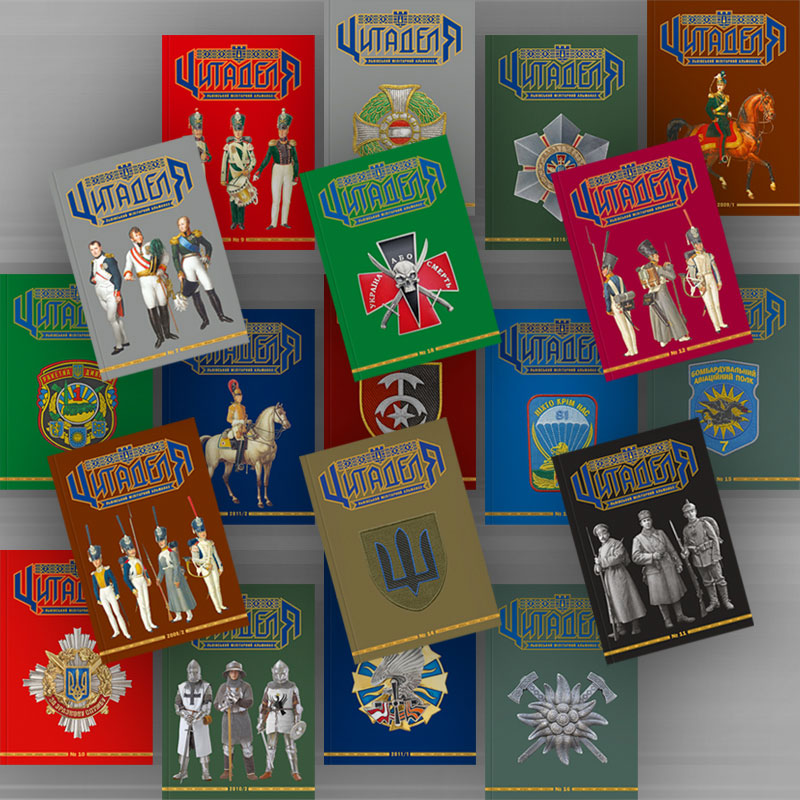
A military-historical periodical aimed at covering important events in military and political history that had a significant impact on the development of culture, art, science, technology and military affairs in Ukraine and the world, as well as contributing to the country’s defence capability. It is published since 2009.
THE LVIV MILITARY ALMANAC CITADEL was founded in 2009. To date, 19 of its issues have been published. It is published in printed and electronic forms.
You can see the contents of The Citadel issues on the website of Astrolabe Publishing in the Periodicals section.
This is the first modern Ukrainian military-historical periodical, which can rightfully be considered the inheritor of the traditions of the Chronicle of Red Viburnum, which was published in Lviv in 1929‒1939. The purpose of its publication is to cover important events in military and political history that had a significant impact on the development of culture, art, science, technology and military affairs in Ukraine and the world. The creation of the almanac was also motivated by an important motive: to contribute to the defence capability of the country, which was rapidly weakening due to the dominant for a long time the pernicious way of thinking of its cultural, intellectual and political elites.
ALMANAC EDITORIAL BOARD:
Prof. Dr. Oleh Feschowetz, editor-in-chief, founder of Astrolabe Publishing, professor at the Ukrainian Free University in Munich;
Dr., Retired Colonel Mykhailo Slobodyaniuk, deputy editor-in-chief, head of the Museum of the Hetman Petro Sahaidachnyi National Army Academy;
Alexander Diedyk, deputy editor-in-chief, issuing editor of the almanac, military historian.
THE ALMANAC COOPERATES WITH:
Lviv Regional State Administration, Lviv Regional Council, the Borys Voznytskyi Lviv National Art Gallery, Lviv Historical Museum, Central State Historical Archive of Ukraine in Lviv and other institutions. Publication and distribution of almanac issues is carried out by Astrolabe Publishing.
ALMANAC MISSION:
Representing our almanac for the first time, we would like to outline clearly a mission vested in this periodical — one of issues arising in Ukraine currently. Certainly, the rapid increase of number of magazines concerned with military subjects speaks for the manifest demand for them, but at the same time also a certain problem: the fact that they appear so late — only in 10–15 years since we gained the Independence — also bears evidence of an apparent, for those who are able to notice it, defect. The significant war events in which many our compatriots were fully engaged are forced out of our history in a strange way. And consequently the whole military sphere of human existence, army as such and technologies, a culture, personal virtues related to it are perceived by us as some distant, extraneous, even strange things, too. This suggests the reason why we have not our own military history, and just trying for the first time to write it face accusations of an attempt of the aforethought “re-writing”. And it seems that is why our thinking is dominated by some strange pacifism based on the groundless belief that in our world it is possible to hide out, that one should not take part with somebody and peace as such can come out of something else, not of some purposeful action, in particular military one.
Probably, this way of thinking is inherent to the peoples designated by Georg Hegel as “unhistorical”. However hardly anybody perceives adequately such designation of his nation and does not respond to it as to an offense. This affords us ground to hope that our efforts will not be vain and the almanac will find thankful readers.
Today the time has come for the revision — without prejudices, but with due consideration and respect — of the military history’s pages that directly or indirectly refer to our country describing the events in which our ancestors took an active or passive part, the events that leaved some deep or barely perceptible imprint on our life or fully changed the course of our history, lacerated us or revitalized, enriched or impoverished. Without prejudices — because facts require just this attitude. But with a favour — because just this orientation will help us to see the things ignored by official historiography of other states through the centuries. Only due to such paradoxical, on the face of it, approach we will get a chance to write our more complete, more comprehensive history. This is not about an attempt to substitute the old imperial mythology by a new, already Ukrainian one. Such reproach would be undeserved, or rather projected on us by mistake. Humankind believes in nothing like a lie passed on by word of mouth, as once Denis Diderot said. To our opinion, many a position of the conventional historiography has status of such “truth” pretending to undoubtfulness. Through the centuries living, working, co-creating European history, fighting and dying on the fields of European battles, we must — because of our centuries-long ungoverned status — speak in our own voice as it were for the first time. Therefore we accept the accusations of “re-writing” the history as groundless and being over compensating to perceive them seriously. Actually, it is a tragic fact that the original Ukrainian history is not yet written and our voice in the polyphony of new Europe is too weak until now.
No doubt, such task exceeds the ability of only one magazine and its authors are and will be neither the first nor the last among those who set or will set such goal. But now the time has come to renew our efforts. We have a chance to touch up the newest history of European civilization, to add that very touch that only we can and must add, because, as Taras Shevchenko said, “in one’s own house, — one’s own truth, one’s own might and freedom…” To add open-mindedly, without hatred and vindictiveness, being ready for the permanent dialogue and full of self-esteem, open to new interpretations and heedful of facts, conscious of variety of ideas and our own right to our own convictions. We expect that our almanac will be a rightful place for such attempts.
At the same time the mission of this edition is not limited to historiographical tasks. This follows from the nature of history as such. None other than Martin Heidegger paid attention to special nature of historical time. So in a great measure our efforts will be determined by our vision of the future. By available means we will try to prepare our readers to challenges issued by the future. We will try — without regard to the “unheroic” spirit of our time — to cultivate the virtues that through the centuries enabled one people to occupy a rightful place among free nations of the world. We consider sincerely that Friedrich Nietzsche’s words that “not your sympathy, but your courage rescues victims until now” carry conviction today. One should not reject courage, self-sacrificingness, discipline and patriotism as some unsuitable for modern life antiques, in fact the price of neglect of them, as our history showed, and not only our history, is excessive.
We call all who shares our views, irrespective of cultural, national or political affiliation, for the collaboration. We expect that due to consolidated efforts and permanent dialogue we will be able to offer to the society more detailed vision of the military history of our country and all of Europe, the vision that without our participation in her forming is doomed to remain incomplete and simplified, and thus — partially unreliable.
Oleh Feschowetz
January 4, 2009, the city of Lviv